Caffeine and Coffee

Caffeine blocks sleep receptors and triggers dopamine, adrenaline, and improved breathing—extracting roughly 8mg per gram of coffee used.
- Caffeine works by blocking adenosine receptors that make you sleepy, while triggering adrenaline and preserving dopamine for alertness
- Calculate caffeine content easily: multiply grams of ground coffee by 8 (e.g., 18g espresso = ~144mg caffeine)
- Caffeine's half-life is 4-6 hours, meaning half remains in your system by midday if consumed at 7am
If you ask anyone, save a chemist, about caffeine intake, reactions and the amount extracted in coffee - the answers will most likely be a hodgepodge of mother-in-law wisdom and Google falsehoods. Since we get this question all the time, we want to help demystify exactly what caffeine is, how it works, and how much is in your coffee or espresso.
What is caffeine and how does it work?
You know the pleasant clarity you feel after your first espresso or drip coffee? That caffeinated glow is really the result of four distinct compounds:
Adenosine
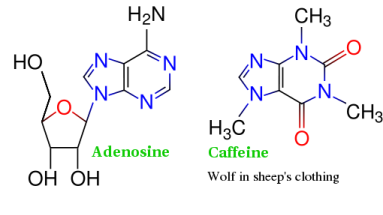
Caffeine helps coffee drinkers become more alert by blocking adenosine receptors in the brain. Adenosine is a chemical your body produces to help you sleep. It binds to receptors in your body to complete a chemical reaction that slows your body down, lowers blood pressure and dilates blood vessels in order to provide good oxygenation for slumber. As caffeine shares a similar chemical structure, it can also bind to these adenosine receptors and negate the effect. With fewer receptors available, neural activity speeds up, making the drinker feel more alert. This is one reason why it’s so hard to sleep after caffeine.
Adrenaline
All that extra brain activity has a second effect: it causes the body to produce adrenaline. As your mind starts speeding up, the body is tricked into believing it is in a threatening situation, so it starts to produce low doses of adrenaline. The adrenaline gives the drinker a little boost of energy. Have you ever had one cup too many and your hands started to feel a little shaky? It’s a sign your body is reacting to the extra adrenaline the same way it would in a stressful situation. It’s fight or flight and your body is getting ready for action.
Dopamine
Just like the bit of sweetness that balances the bitter in a great espresso, caffeine helps balance some of the adrenal stress by blocking dopamine reabsorption. Dopamine does a lot for our brain, but the key feature is the feeling of euphoria it creates. When you consume caffeine, it prevents your body from breaking the dopamine down, meaning you’ll have more of the feel-good compound in your system for longer. Early research suggested that caffeine actually produced dopamine - much like anti-depressant medication (and some illicit drugs, such as cocaine). However, it is now known that dopamine isn’t produced, it is simply blocked of its reabsorption - making it last longer. This feeling is addictive, however, as we all know.
Theophylline
Theophylline is a bronchodilator. It relaxes the blood vessels and smooth muscles of the body, increasing the ability to breathe. While caffeine has no impact on Theophylline, it looks so much like the compound from a chemical perspective that it tricks the body into thinking it is. This is one reason why cyclists love caffeine so much. It increases lung function. This easing of the smooth muscles is also known to cause a well-known effect in humans: bowel movements. This is not scientifically proven yet, but the causal evidence exists. It isn’t a diuretic, however. Science debunked that myth in 2015.
How much caffeine is in my coffee?
Like so much in coffee, the short answer is – it depends. In order to find out how much is in your drip coffee or espresso, we have to do a little digging and a little math.
In roasted arabica coffee, caffeine makes up roughly 1% of the total composition. Despite what you may have heard, this is true regardless of roast level. Caffeine can easily endure the high temperatures required for roasting coffee without breaking down or being cooked off. This means for every 10 grams of roasted coffee, there is potentially 100 milligrams of caffeine to be consumed.
But most of us don’t eat roasted coffee straight. Instead, we drink a solution of dissolved organic compounds and water, or, you know, coffee. This means it is highly unlikely that’d we extract all of the caffeine available in our ground coffee. Generally speaking, we extract 80-90% of the caffeine during brewing. So to find out how much caffeine you’re consuming, simply multiply how much ground coffee (in grams) you’re using to brew by 8:
The amount of caffeine will change slightly depending on the filter used to brew. While paper filters will keep small particles of coffee from ending up in the cup, metal and cloth filters (espresso, french press, etc.) allow the coffee sediment to pass into the beverage. These small pieces of coffee still have the leftover caffeine and will, therefore, increase the caffeine content a small amount.
How long does caffeine last?
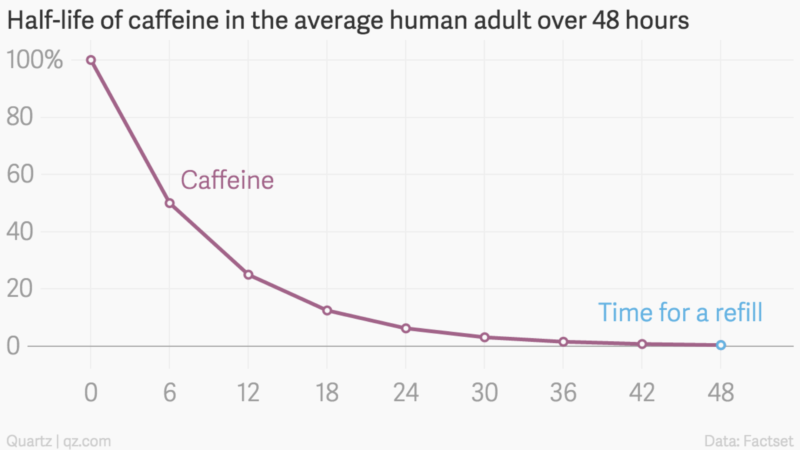
99% of ingested caffeine passes into the bloodstream within 45 minutes of ingesting. The half-life of caffeine, (i.e., how quickly it metabolizes half of the amount in your body), is around 4-6 hours. That means that if you ingest 300mg of caffeine at 7am, by noon, 150mg will still be acting upon your body. As with most chemical compounds, this metabolism occurs in a downward curve. The “crash” you feel when metabolized, however, is a result of all of those above reactions being reversed - most notably the Adenosine receptors being freed up to make you sleepy once again.
Why is there caffeine in coffee?
Caffeine is a naturally occurring substance found in a variety of plants, most commonly coffee, tea, and chocolate. According to evolutionary biologists, caffeine offers a few key benefits to the plant that help it survive and thrive.
Caffeine is a surprisingly effective pesticide. While it would take 10 grams of pure caffeine to cause on overdose in a human, it takes just a little to kill off your average insect. To avoid this jittery end, many insects have sensory receptors that help them identify caffeine. Additionally, caffeine helps coffee plants gain an advantage over other plants wanting to grow nearby. Extra caffeine ends up in the soil as coffee plants drop leaves or die, making it harder for other plants to take seed and steal resources.
Caffeine isn’t only a deterrent. The nectar of the coffee plant features a very small amount of caffeine. Insects that swoop in to feed off the nectar get a nice caffeine buzz and soon enough, they’re returning for another hit of the good stuff.
Sources:
How Caffeine Evolved to Help Plants Survive and Help People Wake Up
For Coffee Drinkers, the Buzz May Be in Your Gene
Sorry, But Bananas Won't Calm Your Caffeine Jitters
Science Just Debunked a Coffee Myth That’s Been Around Since 1928