All Things Flow Control
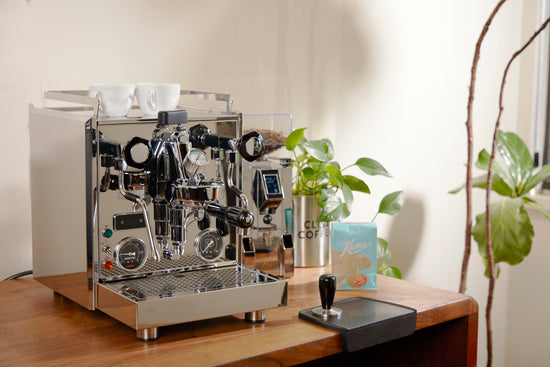
Flow control lets you adjust water flow during espresso extraction to influence flavor, useful for experimentation and potentially saving imperfect shots.
- Flow control devices like LUCCA's E61 attachment let baristas manipulate water flow rate to change espresso extraction and flavor profiles
- Flow and pressure are inseparable — changing one automatically affects the other based on your grind, dose, and tamp resistance
- Beginners can use flow control to rescue shots pulling too fast or slow, but mastering grinder quality and technique remains essential
If you’ve spent even just a couple of seconds on the barista forums or in the black hole of espresso videos on YouTube, you’ve probably seen the terms, if not a warzone of comments, about flow control and pressure profiling. Recently, our product development team at Clive, LUCCA, launched a flow control device that can attach to an espresso machine with an E61 group head and allow baristas to control the flow (hence the name flow control) of water to change coffee extraction. If you’re brand new to all of this and are wondering what “changing coffee extraction” means, basically, you can get very nerdy with espresso and bring out different flavors from coffee when you change how you brew it. One way to do this is by changing the flow rate of water!
First things first, we’ll say — flow control isn’t for everyone. It doesn’t guarantee a better coffee, and often, when you’re first starting out making coffee at home, simplifying things can be better! If that’s what you need, start here. A plus to flow control when you’re new to home espresso is that it can help you save bad shots. Which, when you’re starting out, you’ll have a lot of… For example, if your shot is pulling too fast, you can slow down the flow of water, which will slow down the shot, and cross your fingers that will help. As we always say, to tell if a shot is good or not, you have to taste it.
As coffee professionals, we hear people talking about flow and pressure profiling or control in many different ways so, we wanted to lay out some general terms for the sake of clarity, talk about how you can use these techniques and devices to improve your coffee, and how to get started. So, we sat down with the Head of R&D and Product Manager at LUCCA, Ben Guiles, to get started.
A few key takeaways:
- Understanding the terms profiling and control. Profiling is what the barista is trying to do—changing variables to impact a coffee. Control refers to the device you use to do it. For example, pressure profiling is the practice (or art, some would say) of adjusting pressure to influence how a coffee extracts. Pressure control would refer to a paddle, an expansion valve, a PID, any device you use to change pressure. Some people use profiling and control interchangeably and we don't see a big problem with that.
- How pressure and flow impact a shot of espresso. Pressure is the measure of the force behind water. Flow is the measure of how quickly water is moving through something.
- Flow and pressure are related to each other. You can't change one without changing the other. If you keep resistance the same (meaning the grind size, dose, and how you tamp), and you increase pressure, flow will increase. If you decrease pressure, flow will decrease.
- Though flow control devices can help you adjust your shot on the fly, potentially saving it, they aren't miracle workers. You still need a quality grinder, a great machine, and proper technique.
- Become comfortable throwing the rules out the window. With the ability to adjust pressure, you an extend shot times and volume. It's for those wanting to experiment!
- A good place to start with a flow control device is doing a slow ramp up and a slow ramp down. This means having the paddle closed (to the left) and then slowly moving it open towards the right to increase the flow and then back down again.
Want to see the LUCCA Flow Control device in action?
Looking for more on flow profiling and ready to geek out? Check out our blog: Flow Profiling 101 or take Advanced Espresso through Coffee School to dive into all things extraction.