How to Choose a Heat Exchanger Machine
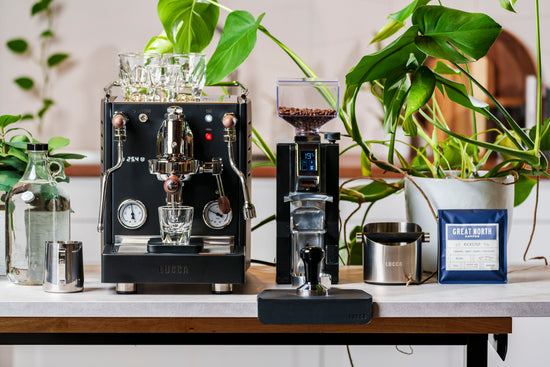
Heat exchanger espresso machines use a single steam boiler with a brewing coil, offering dual-boiler power in a compact footprint—ideal for home baristas prioritizing milk drinks and simplicity over precise temperature control.
- Heat exchangers simultaneously steam and brew using one boiler and a coil, combining commercial power with home-friendly size
- Most HX machines brew within 192–204°F without single-degree control; models like Profitec Pro 500 and LUCCA X58 add PID precision
- Cooling flushes (5–10 seconds before each shot) are required to stabilize brew temperature after idle periods
- Budget-conscious buyers should consider the Profitec Pro 400 (~$1,600), while those wanting compact power prefer the ECM Mechanika VI Slim
What is a heat exchanger?
A heat exchanger (also referred to as HX) is an espresso machine with one boiler that is dedicated to steaming milk. Rather than having a second boiler dedicated to brewing, like a dual boiler, or using the same boiler for both steaming and brewing, like a single boiler, heat exchangers have a coil attached to the steam boiler that rapidly heats water as it passes through, and is then used for brewing. This allows users to steam milk and pull shots simultaneously or back-to-back immediately.

Photo: Lelit Mara X espresso machine and Eureka Specialita espresso grinder
What are the advantages and disadvantages of having an HX machine?
Heat exchangers are often used in commercial settings as they have lots of steaming power, the ability to make a ton of drinks back to back, and can simultaneously steam milk while pulling a shot. An advantage to having one in the home is its ability to pack the power of a dual boiler machine into a smaller footprint.
Most heat exchange machines don’t provide a way to control brewing temperature to one degree, which is seen as a disadvantage for many baristas. However, heat exchange machines are guaranteed to brew in a suitable range for espresso to ensure the coffee is extracted properly. Standard HX machines temperature surf, which means the boiler will bounce between its lowest and highest setting to stay in the range. This can be seen as a negative as you’re not guaranteed a specific brew temperature. However, the water will never be too hot or cold for espresso, it just can’t get as precise as some baristas want. HX machines with PIDs like the Profitec Pro 500 and the LUCCA X58 have a PID, which is a digital interface that allows for temperature control. In an HX machine, this looks like controlling the steam temperature, which directly affects brewing temperature.
If you've seriously looked into HX machines, you've probably come across the term "cooling flush." This isn't necessarily a con, but it is an added step. Since water used for brewing passes through the coil attached to the steam boiler, when the machine sits idle, that water gets extremely hot. It's important to purge water from the group head to stabilize the temperature back to what's appropriate for pulling a shot. This cooling flush should be for 5-10 seconds before every shot pulled.
A few years back, we answered a commonly asked question, “Heat Exchangers with PIDs: Are They Worth it?”
The Pro 400 from Profitec and Mechanika VI Slim by ECM have a 3-position switch that controls the boiler's temperature, giving you a low, medium, and high setting that equates to about 194 degrees, 201 degrees, and 208 degrees. For most, this is enough option and control. For others who want to play with temperature as a way to change how a coffee extracts, this isn’t precise enough. In addition to a 3-way temperature switch, the Lelit Mara X allows for Brew X and Steam X modes, helping you focus more on one task. If you prefer espresso, the brew X mode gives you more back to back temperature stability. If you want to steam a few milk drinks back to back with a little steam boost, the Mara X's steam x mode will get you there.

Photo: Profitec Pro 400 Espresso Machine and DF64 Espresso Grinder
Why does brewing temperature matter?
When making coffee, you need the perfect combination of grind size, time, and water temperature to pull all of the great flavors out of coffee—this is extraction. Brew time and water temperature can almost be interchangeable—for example, cold brew. To make cold brew, coffee grounds soak in room temperature for 24 hours. When you use hot water, you can extract much more quickly. Since espresso is such a quick brewing method, you need very hot water. The range for espresso is between 192 and 204 degrees. You’ve probably seen a variance in the range suggested by other coffee professionals. This is what works for us and is not a hard rule but generally, good guidelines to follow. Depending on the coffee you use and its roast level, it may need hotter or cooler water when brewing to ensure proper extraction and delicious result. As you know, you can get pretty nerdy with coffee brewing. Changing temperature is one of those variables in making coffee that can be fun to mess with, but to new baristas and less experienced palates, results might not be noticeable in the cup.
You can read about how to use water temperature to play with coffee extraction and how to brew based on the roast level in our article How to Brew Light, Medium, and Dark Roasted Coffees.
If you don’t see yourself as someone who wants to mess around with brew temperature or is okay with less precise brew control, and you want something powerful, reliable, simple, and small, a heat exchanger is a great option. So how do you narrow it down?

Photo: LUCCA X58 Espresso Machine and Eureka Atom 75 Espresso Grinder
How do you choose between HX machines?
These machines generally do the same thing. They all have very similar internals— vibratory pumps, water reservoirs, and E61 group heads.
- Features: Do you want a PID or temperature control? Check out one of these three: Profitec Pro 500, LUCCA X58, Profitec Pro 400, Lelit Mara X, and ECM Mechanika VI Slim.
- Budget: Our favorite budget pick is the Profitec Pro 400. It’s super compact and sits right around $1600.
- Aesthetics/Brand: Here, we choose the ECM Mechanika VI Slim. It’s the smallest HX machine with the most power and features stylish rotary valves.